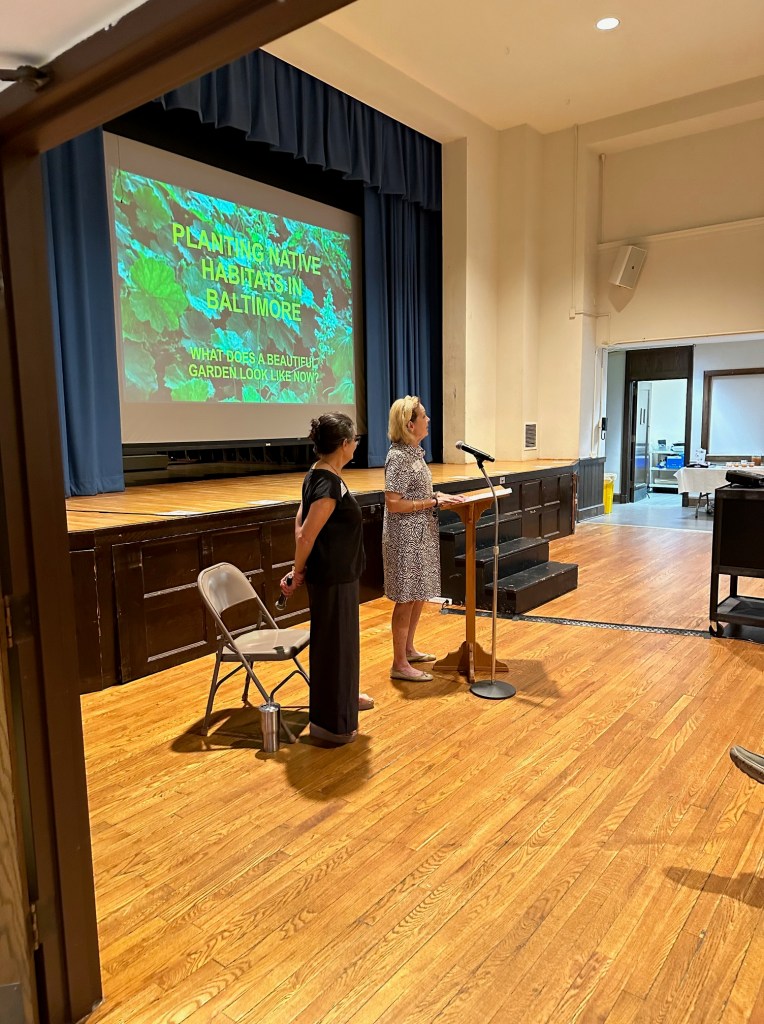
Debbie Swartz, a Baltimore City Master Gardener, gave a captivating presentation on how to rethink our yards and transform them into thriving, sustainable habitats. The event was proudly sponsored by the Homeland Garden Club and the Homeland Association and welcomed more than 100 neighbors and friends from the community.
The discussion focused on the urgent need to plant native trees and plants, especially in urban neighborhoods to protect our tree canopy, support local wildlife, and fight the effects of climate change.
Why It Matters
In natural forests, trees and plants regenerate on their own. But in urban areas like Baltimore, preserving green spaces and the tree canopy requires intentional planting of native species. Native plants are well-adapted to our region’s climate, needing less water, fertilizer, and maintenance. They also support beneficial wildlife, prevent erosion, and improve soil health.
Without native plants, our yards become green deserts that are attractive but ecologically empty, offering little food or shelter for birds, butterflies, bees, and other vital pollinators.
Historically, lawns were designed as open spaces to help spot approaching enemies. Today, we must rethink these areas as opportunities to support biodiversity and restore local ecosystems. By shifting from purely decorative gardens to habitat gardening, we can create outdoor spaces that are not only beautiful, but also ecologically meaningful.
What is Habitat Gardening?
Habitat gardening is the practice of designing your yard to work in harmony with nature. It involves planting native species, gardening organically, preventing erosion, and supporting natural environmental cycles.
To create a self-sustaining ecosystem, gardens should be planted in layers, much like a natural forest. Begin with large trees, such as White Oaks or Magnolias, to form a canopy. Beneath them, plant smaller trees and large shrubs to create a sub-canopy. Add another layer with smaller shrubs, bushes, and flowering plants, and finish with ground-level vegetation like native grasses, ferns, sedges, and perennials.
This layered approach helps build a healthy, balanced habitat that supports biodiversity and strengthens the local environment.
Native Trees for Homeland
White Oak (our most important keystone species)
Black Cherry
Eastern Redbud
Sweet Bay Magnolia
Red Maple
Native Plants for Homeland
For Birds: Winged Sumac
For Pollinators: Mountain Mint, Joe Pye Weed, New England Aster
For Butterflies: Milkweed, Spicebush, Parsley
For Hummingbirds: Cardinal Flower, Bergamot, Honeysuckle
Steps to Turn Your Yard into a Habitat
- Remove Invasives: Use plant identification apps to help spot invasive species, then remove them to give native plants the space they need to thrive.
- Start with Trees: Begin by planting large trees and place them thoughtfully. Oaks on the south side of your home can provide cooling shade, while evergreens on the northwest side can serve as a windbreak.
- Plant Trees in the Fall: Skip spring planting—fall is better for root establishment. For new trees, water often and deeply during their first 3 years.
- Use Mulch Wisely: Apply 2–3 inches of mulch in a donut shape (not volcano-style) around trees to protect roots and retain moisture.
- Create Pathways: Incorporate permeable surfaces like stone pavers or pebbles to reduce runoff and stabilize soil.
- Replace Non-Native Plants: After removing aggressive species, gradually add native shrubs, bushes, ferns, grasses, and perennials.
- Reduce Your Lawn: Lawns require chemicals and constant watering. Replace a foot of grass each year with garden beds filled with native plants.
- Add Wildlife-Friendly Features: Provide a water source, such as a bird bath, and use mosquito dunks instead of chemical pesticides to control pests safely. Dim exterior lights or switch to yellow bulbs to help birds and insects navigate more easily at night.
- Plant for Future Generations: Create a living legacy by planting a tree for every child born in your family. Teach them how to care for it while passing on a stewardship ethic.
By making these changes, we can all play a role in building a healthier, more vibrant Homeland—one yard at a time.
 Homeland Garden Club
Leave a comment